What are PFAS?
PFAS (per- and polyfluorinated alkyl substances) are a class of nearly 15,000 chemicals used to make products resist grease, oil, water, or heat. Many products contain PFAS including cookware, cosmetics, clothing, carpets, and firefighting foams. PFAS are also widely used in industrial processes and then discharged into waterways or released into the air.
Known as toxic “forever chemicals” because they do not break down in the environment, PFAS have contaminated more than 9,728 drinking water, industrial, and military sites across all 50 states. According to the US Geological Survey, over 45% of all tap water in the US is contaminated with PFAS. Researchers are also finding it in breast milk and house dust.
A growing body of scientific research has found links between PFAS exposure and a wide range of health problems including weaker immune systems, cancer, increased cholesterol levels, pregnancy-induced hypertension, liver damage, reduced fertility in men and women, and increased risk of thyroid disease.
Why Defining PFAS Matters
Despite mounting health concerns, the chemical lobby has sought changes to the scientifically grounded definition of PFAS that would create regulatory loopholes. Currently, nearly half of U.S. states define PFAS in a way that includes all forms of the chemical, including polymers (plastics) and gases. However, industry groups that financially benefit from continued production and use of PFAS continue to push for narrower definitions that exclude widely used PFAS.
Governments Are Using a Scientifically Grounded Definition of PFAS for Restrictions
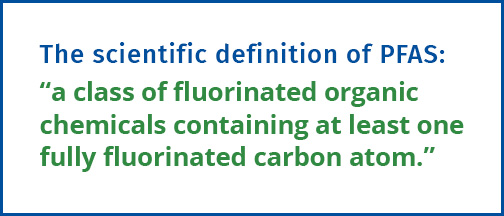
There is broad scientific consensus that supports defining PFAS as “a class of fluorinated organic chemicals containing at least one fully fluorinated carbon atom.”
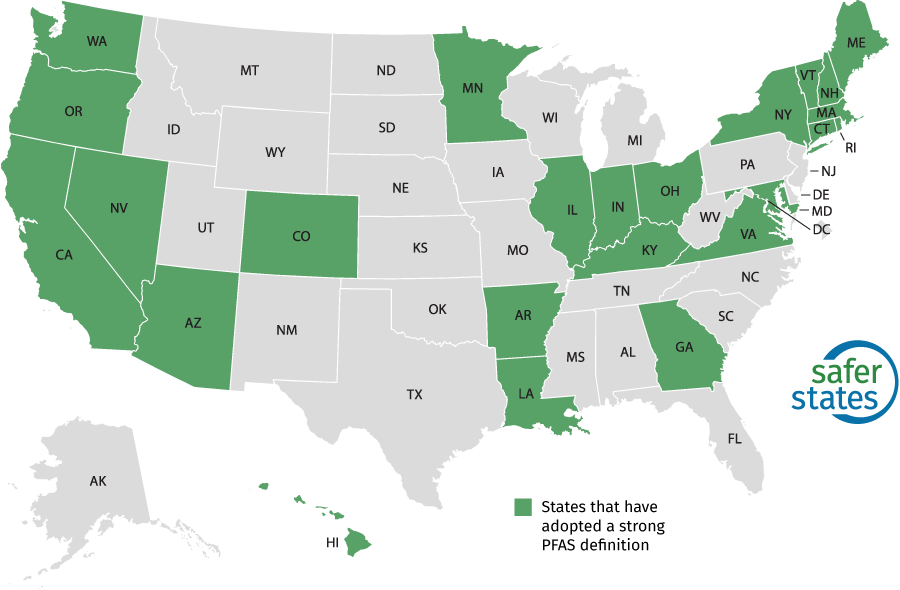
This widely adopted definition has been used in state and federal legislation since 2018, creating important consistency for manufacturers, retailers, and regulators. This definition has been adopted by:
- At least 24 states, including AR, AZ, CA, CO, CT, GA, KY, HI, IL, IN, LA, MA, MD, ME, MN, NH, NV, NY, OH, OR, RI, VA, VT, and WA.
- Congress, through the National Defense Authorization Act in 2021, 2022, and 2023.
Science-Based Definitions Are Critical for Strong Protections
All PFAS, including polymers and gases, contain at least one carbon-fluorine bond. These chemical bonds are the strongest single bonds in organic chemistry and it is what makes these chemicals virtually impossible to break down in the environment, which is why they are often referred to as “forever chemicals”.
However, PFAS manufacturers claim that certain PFAS, including polymers and gases, are safe — but this is not the case.
The science-based definition of PFAS includes:
- PFAS polymers or “fluoropolymers”, which are a plastic version of PFAS and are used in consumer products and manufacturing. The manufacture and disposal of these products pollutes air and water.
- Fluorinated gases, which are PFAS used in refrigerants and some HVAC equipment despite the presence and use of safe and effective alternatives already on the market. The use of these PFAS is increasing the amount of harmful pollutants in drinking water and fluorinated gases are now the main source of PFAS pollution globally.
Evidence from whistleblowers and archived company records demonstrates certain PFAS manufacturers didn’t disclose to the public the toxicity of PFAS for decades. Many of the manufacturers and users of PFAS are claiming that PFAS polymers and gases are safe, even though evidence suggests otherwise.

States Cannot Rely on the EPA’s Current Definition of PFAS
The EPA has been inconsistent and unclear when it comes to the question of what set of chemicals should be labeled a PFAS, instead relying on a case-by-case approach generating criticism from prominent scientists. One of EPA’s definitions of PFAS excludes several problematic PFAS that are used in cosmetics, cleaning products, plastics, and electronics.
To simplify and streamline legal compliance for industry and to protect communities, states across the country are using the scientifically-grounded class-based definition for PFAS. Coordinated state laws and regulations are successfully reducing PFAS use across the country.
Want to learn more?
- Return to the homepage
- Search the Cookware Brand Chemicals Disclosure Directory
- Detox your kitchen! A few simple steps can reduce your exposure to toxic chemicals starting today
- Learn how state laws are improving cookware safety nationwide
- Check the facts: Are PFAS safe for food-contact materials like cookware?
- Dig in to what the experts say about PTFE, the PFAS plastic most commonly used in cookware
- Take Action: Demand that big retailers and cookware brands stop selling PFAS cookware nationwide!
This information (accessed July 2026) is courtesy of Safer States, an organization founded in 2005 by Clean Water Action-Massachusetts, Defend Our Health (then Environmental Health Strategy Center), and Toxic–Free Future (then Washington Toxics Coalition) to support state chemical policies that would serve as models for and propel reform of the federal Toxic Substances Control Act (TSCA).
Safer States is a national alliance of environmental health organizations and coalitions from across the nation working to safeguard people and the planet from toxic chemicals, and to ensure availability of safer solutions for a healthier world. Led by state-based organizations, the alliance seeks government and corporate action that lead to safer chemicals and materials, and protection of public health and communities by transitioning away from harmful chemicals and holding chemical polluters accountable. Safer States is a fiscally sponsored alliance housed at Toxic-Free Future and is governed by a Steering Committee of representatives from seven states (currently Connecticut, Massachusetts, Maine, Michigan, Minnesota, New York, and Washington).